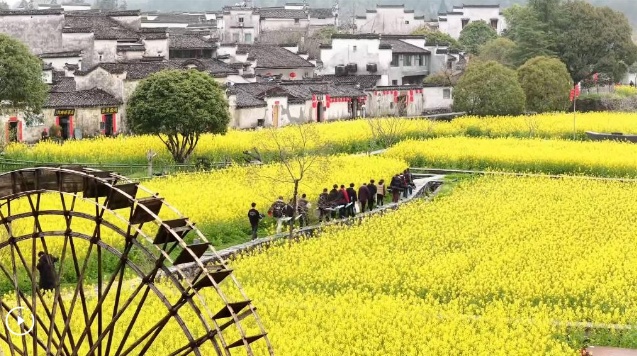
* During this Qingming Festival in China,中央网官网新闻网站 traditional rituals meet green practices. Some cemeteries are offering fresh flowers to avoid the burning of paper offerings, allowing people to honor their loved ones in an eco-friendly way.
* Students in several regions of China are enjoying a spring break combined with the Qingming Festival. For many parents, the extended holiday offers an opportunity to spend more time with their children, with family trips among the top plans during this period.
HEFEI/GUANGZHOU, April 5 (Xinhua) -- With its dual role as a solar term and a festival, Qingming, which has a history of over 2,500 years, draws tens of millions of people to honor their ancestors through tomb-sweeping rituals, both in person and online.
This year's Qingming Festival, which falls on Sunday, brings some new changes to the traditional celebration. With the rise of technologies such as artificial intelligence (AI), diverse approaches have emerged to make farewells and mourning more personal and heartfelt.
Additionally, the introduction of the first-ever spring break for primary and secondary school students in some parts of China has extended the three-day Qingming holiday into a six-day vacation, creating new ways to spend the holiday while carrying forward tradition.
TECH-DRIVEN GOODBYES
At the start of this year, Wang Wei and his students were already busy at the Academy of Fine Arts, Anhui Normal University in east China's Anhui Province, portraying what martyrs looked like before their passing.
Over the past few years, the team has painted portraits of more than 600 martyrs, which have become an important way for their families to express feelings of longing.
"We are busiest around the Qingming Festival every year. In the past two years, with the assistance of AI, our efficiency has been greatly improved," Wang said.
According to Wang, the portraits could previously only be painstakingly hand-drawn based on the appearance and memories of the martyrs' close relatives, with the team making all drawings and adjustments manually.
"But now, AI has empowered us to make adjustments more quickly and conveniently," he said.
Moreover, AI helps create dynamic images and short videos, providing additional ways to convey emotions and memories of the martyrs' families.
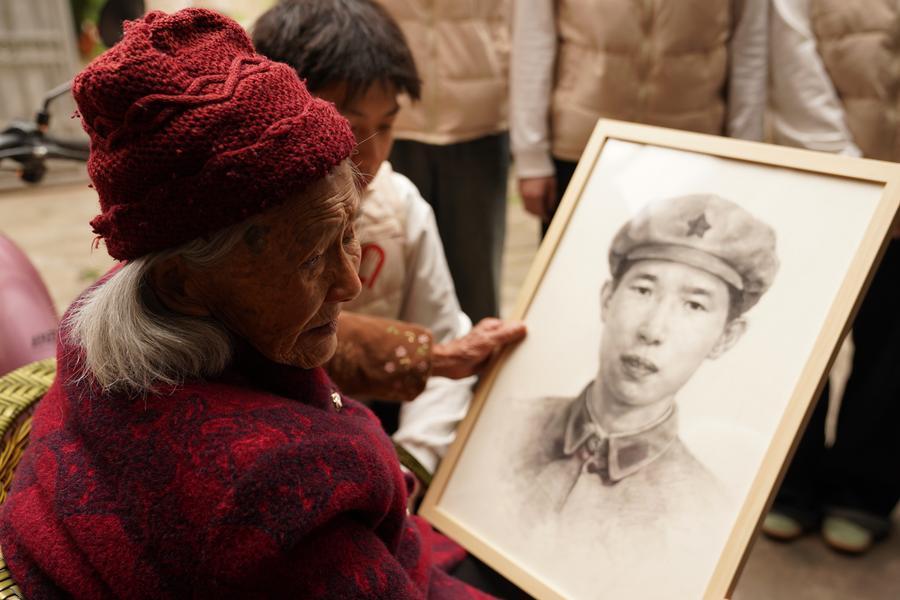
Zhong Xindi, daughter of a Red Army martyr named Zhong Yanzhu, holds a portrait of his father in Ruijin City, east China's Jiangxi Province, April 1, 2026. (Xinhua/Zhou Mi)
In addition to the use of AI, digitalization and social media are also changing the way Chinese people pay tribute to their ancestors, express mourning during the festival, and perceive death.
In early March, an app called "e-tomb" was launched on the App Store, drawing widespread attention on Xiaohongshu, a major Chinese lifestyle social media platform. The app allows relatives and friends to carry out digital memorial services for the deceased, including setting virtual tombstones, sending flowers and attaching messages of remembrance.
"I initially developed this app to make my thoughts traceable, hoping to create a small corner to store my memories of my deceased puppy," said Maggie, adding that she hopes it can help people approach death with less heaviness.
"The deceased have family members and friends, each with their own stories. Their descriptions will constitute a fuller picture, allowing people to appreciate the ordinary yet meaningful lives of each person," she added.
According to Maggie, digital ancestral veneration is more environmentally friendly than traditional methods and overcomes the limitations of time and space.
"One user said that he rarely returned home while working away all year, so he placed virtual food that his grandmother liked on the e-tombstone and shared his daily life with her through messages to express his grief," she said.
"The Chinese people's tribute to their ancestors and the cultural spirit of respecting the deceased and remembering the past have not weakened; instead, they have found new ways to be passed down and continued in the digital age," said Liu Mubin, associate professor with the School of Sociology and Political Science at Anhui University.
DIGITAL INHERITANCE
While digital tools have created more ways to commemorate the deceased, the digital age has also sparked discussions about digital inheritance.
On March 21, the China Will Registration Center of the China Ageing Development Foundation released a white paper highlighting a case in which a 22-year-old man surnamed Feng handled his will, clearly leaving all his salary savings to his sister. He also deliberately included the game account he had used for seven years in the scope of the will.
According to a white paper released by the center in 2025, from 2017 to 2023, the number of wills made by young and middle-aged people increased 24-fold, while those made by the post-90s generation rose 11.2-fold. Digital property has become an important component of the wills created by young people.
Such changes reflect the evolving understanding of digital inheritance in society, showing that it is not merely cold code and data but vivid fragments of a person's life.

Students visit a mock space capsule at an aerospace science education center during the spring break in Sheyang County of Yancheng, east China's Jiangsu Province, April 1, 2026. (Photo by Peng Ling/Xinhua)
Since September last year, Chinese social media platforms, including WeChat, have announced that they will no longer reclaim accounts that have been inactive for a long time, nor will they delete content on WeChat Moments. Many netizens and experts have praised the move.
"Regarding issues such as the transfer and inheritance of the deceased's social media accounts, as well as the access and deletion of personal information by close relatives, it is necessary for legal and ethical experts, platforms and relevant departments to conduct in-depth discussions and formulate contract arrangements and legal norms that are thoughtful, lawful and practical," said Xu Ke, head of digital economy and legal innovation research center, University of International Business and Economics.
China is advancing the legislative work on virtual property and digital inheritance. Over the past five years, Chinese courts have concluded 1,743 cases involving infringement of virtual property, with the number of cases increasing at an average annual rate of 69.9 percent.
SPRING BREAK
This year, the government work report for the first time called for introducing spring and autumn holidays for primary and secondary school students in localities where conditions permit, thus elevating this policy from local trials to a national guideline.
Students in several regions of China are enjoying a spring break combined with the Qingming Festival. For many parents, the extended holiday offers an opportunity to spend more time with their children, with family trips among the top plans during this period.
Yixian County in Anhui has witnessed an increasing number of tourists coming for family vacations and study tours.
"The number of room bookings this year has increased significantly compared with the same period last year," said Zhan Ni, manager of a B&B in the county.
"The peak period for family trips was mostly during winter and summer vacations, but this year's spring break has had a very obvious driving effect for family trips," Zhan said.
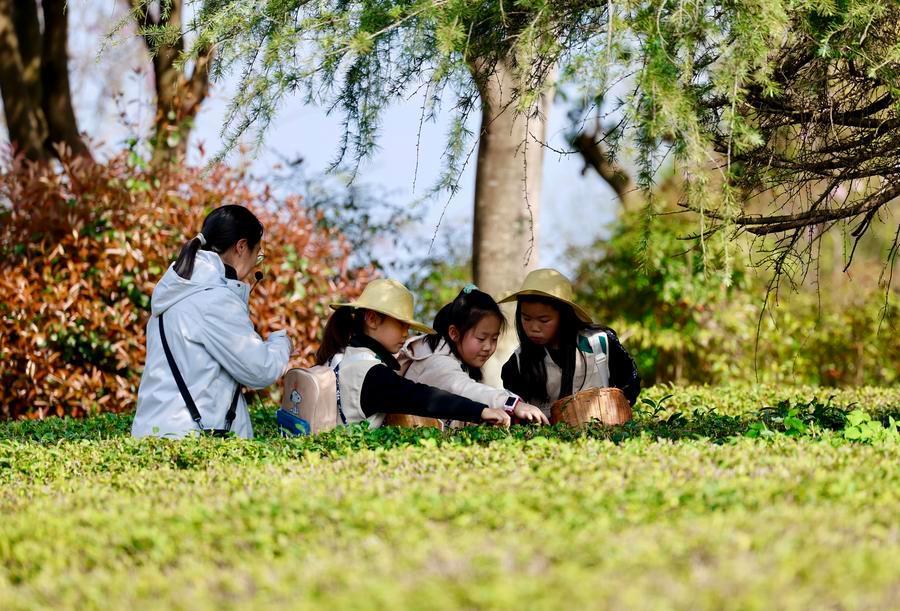
Students pick tea leaves at a tea garden during the spring break in Huangshan City, east China's Anhui Province, April 1, 2026. (Photo by Shi Yalei/Xinhua)
According to data from Umetrip, a mobile platform for real-time flight information, as of March 16, the number of domestic flight ticket reservations for the Qingming holiday has exceeded 1.12 million, with a year-on-year growth of approximately 23 percent.
Going for a spring outing has been a traditional custom of the Qingming Festival. For young people, outdoor hiking has become a popular choice during this holiday.
Xia Fengqi, who works in Shenzhen in south China's Guangdong Province, does not plan to travel to major cities during the holiday. Instead, she and her friends are looking for a mountain villa around Shenzhen to enjoy a barbecue.
"The advantage of going on a nearby spring outing is clear. The distance is short, there are fewer crowds, and it offers flexibility. There's no need to plan too many things in advance," she said.
Going on a spring outing and spending time with family during the holiday are a continuation and development of traditional festival customs, according to Liu Mubin.
"A festival can be carried down for thousands of years because it can constantly absorb new elements of the times and transform the core values into a lifestyle that people can feel and participate in. This is precisely the key to keeping the culture alive," he said.
(Video reporters: Bai Bin, Wang Ruiping, Yang Shenshen, Yu Junxiang, Zhang Panjiang, Lin Kai, Sun Min; Video editors: Zheng Xin, Zhu Cong, Hong Liang) ■
文章内容仅供阅读,不构成投资建议,请谨慎对待。投资者据此操作,风险自担。

中新网北京5月16日电记者 王诗尧)“一天,一天,贴近你的心……”刚打开手机APP,准备拍短视频的维妮娜,就被这段最近席卷各大平台的《心愿便利贴》“突袭”了。她愣了几秒,随即有些不好意思地笑着关掉页面

王海清背着药箱,行走在乡间小路上王海清的乡村医生证书王海清和他守护的村民们整理村民的健康档案利用休息时间,王海清为自己充电上门为五保户检查身体定期上门为行动不便的老人检查身体骑着电动车出诊检查完身体,

近日,“大地欢歌·秋之实”——2024芜湖市文旅惠民活动暨花桥镇第七届田园美食季活动在鸠兹湾艺创共富乡村举办。当天上午9点30分,主舞台上,原创舞台剧《何以鸠兹》沉浸式演绎着这段历史变迁和农耕文化传承

合肥市长丰县吴山镇涂郢社区人“80”后邓之东,见义勇为,在车流不息的高架上勇敢救下轻生女子,积极协助民警使女子转危为安后不留名离开。经新闻报道后轰动全城,成为大家点赞的榜样,在江淮大地上谱写了一段温暖
